



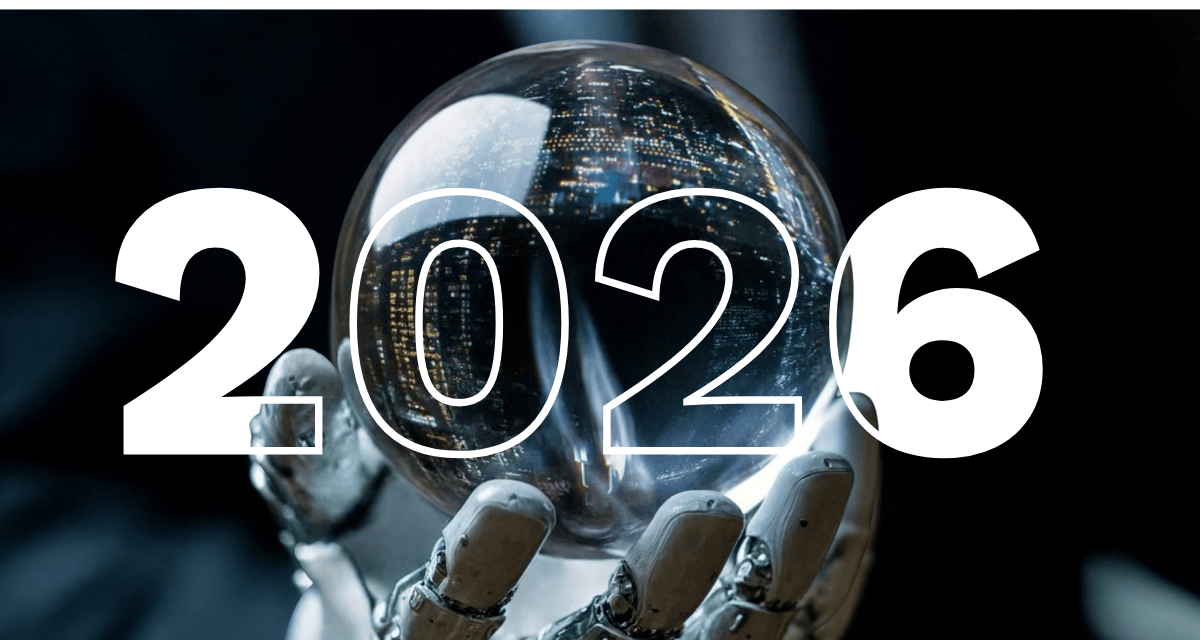
Cloud portability, agentic workflows, governance controls, and human-AI synergy form the 2026 roadmap.
Predictions rarely arrive in perfect sequence, but this year’s outlook from four enterprise technology leaders reveals a striking pattern. Across sectors, 2026 is shaping up to be less about what AI can do, and more about how it scales — across infrastructure, workplaces, governance frameworks, and human collaboration.
The contours of the digital economy are being redrawn not by any single breakthrough, but by the convergence of these layers into a more autonomous, data-aware ecosystem.
To explore what that means in practice, we look at perspectives from four IT enterprises that operate at different tiers of this emerging stack. Their predictions for 2026 trace a coherent narrative of the four layers of enterprise: cloud sovereignty at the base (foundation), integrated intelligence at the core (integration), trusted automation as its guardrail (governance), and human-AI synergy at the edge (experience).
Together, the predictions (edited for length and style) offer a composite view of how technical capability, oversight, and creativity will define the next phase of digital transformation.
Predictions at the foundation layer
APAC organizations will prioritize portability as risk mitigation against geopolitical tensions and vendor lock-in, following EU hyperscaler reduction efforts in 2025. India will lead adoption; Australia will test via large-scale proof-of-concepts. Enables workload movement across providers, regions, architectures without technical/cost barriers — critical for AI computational flexibility. Also:
- Distributed AI architectures: Enterprises will position inference near users/systems to reduce latency, impacting mobility, public services, and industrial automation scaling.
- Expanded AI governance: Coverage will extend beyond endpoints to full data supply chain (training data through model outputs). Real-time prompt/response inspection tools emerge at the edge.
- Shift-left FinOps and regional trends: AI compute volatility will drive real-time cost visibility integration into model design (versions, regions, inference patterns). Asia cloud strategies will shift towards workload portability and data controls. Note: IDC has predicted 80% of APAC CIOs will rely on edge services for AI performance and compliance by 2027.

— Jay Jenkins, Chief Technology Officer, Cloud Computing Services, Akamai
Predictions at the integration layer
APAC organizations will struggle to scale AI business-wide. In 2026, focus shifts from experimentation to structured integration across teams. Other predictions:
- Unified workflows: Tools that connect workflows and applications will gain importance to reduce tech fragmentation and improve knowledge discoverability.
- Bottom-up adoption: Employee-led AI use (drafting, summarizing, task automation) will mirror early cloud patterns. Organizations will channel this into secure enterprise workflows.
- Context-aware systems: AI will evolve to understand organizational context (archives, goals, projects) beyond isolated tasks.
- Workforce development: Firms will prioritize AI skills training and collaborative environments. Human judgment and creativity will remain essential.
- Redefined productivity: Metrics will shift from output volume to insight speed, decision quality, and idea-to-execution velocity.

— Matthew Hong, Asia GTM Lead, Dropbox
Predictions at the governance layer
Agentic AI systems will orchestrate end-to-end workflows with reduced human intervention, moving beyond isolated automation. Based on challenges from 2025, where rapid deployment of AI had exposed vulnerabilities in IT systems, security, data governance, data quality, and outcome consistency, 2026 will see:
- Governance priority: Organizations will have to prioritize oversight, transparency in automated decisions, risk-based controls, and human-in-the-loop review.
- Robust safeguards: Success will require domain-specific AI paired with continuous quality checks and robust safeguards from deployment start.

— Damien Wong, Senior Vice President APAC, Tricentis
Predictions at the experience layer
Agentic AI will support core organizational processes, including customer experience and employee collaboration workflows. Also:
- Customer experience optimization: AI agents will assess engagement timing, type selection (scripted bot, agentic model, voice assistant), and human handoff triggers based on cost, impact, and experience factors.
- Employee workflow automation: Agentic AI will handle repetitive tasks (project updates, meeting scheduling, discussion summarization, follow-ups) and provides proactive recommendations (meeting skip suggestions, pre-meeting briefs with agendas/action items).
- AI quality challenges: Manual correction of AI outputs creates friction. Organizations will explore multiple AI models to improve accuracy, flexibility, and cost efficiency.

— Steve Rafferty, Head (APAC and EMEA), , Zoom