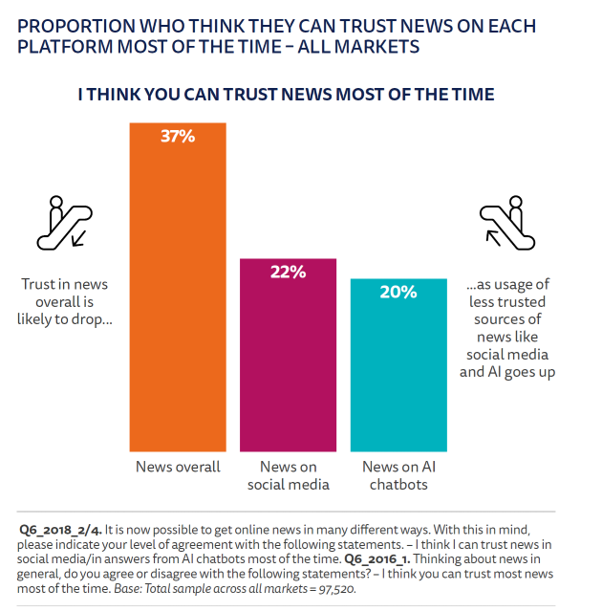






Media trust levels drop across 29 of 48 markets as AI chatbots gain traction, and the usage and credibility gap widens.
According to the Reuters Institute for the Study of Journalism’s 2026 Digital News Report, social media and video platforms have, for the first time, overtaken television as the primary source of news for the audience data analyzed.
The shift marks a turning point in how global audiences consume information, even as overall trust in news continues to erode to its lowest level since the report began tracking the metric in 2015.
Drawing on data from 48 markets, the report found that:
- 54% of respondents had accessed news via social media or video platforms in the past week. That figure climbs to 56% when AI-driven tools such as chatbots are included.
- By comparison, television reached 52% of respondents, while newspaper websites and apps followed closely at 51%, and radio lagged behind at 21%.
- 2026 is as a milestone year, where platform-based consumption has now become the most widely used pathway to news globally.
- Despite this migration, trust in news is weakening. The report shows declining confidence across 29 of the 48 markets surveyed, underscoring a widening gap between usage and credibility.
- People are abandoning traditional news outlets (like newspapers, broadcast TV, and established news websites) — which historically have been viewed as more trustworthy — and moving instead to social media platforms, influencers, aggregators, and alternative sources that they themselves recognize as less reliable.
At the same time, the report asserts that newer channels are rapidly reshaping how news is distributed and consumed. Besides social media platforms, AI chatbots are also gaining traction, particularly among younger users, with adoption rates among under-25s roughly double those of the general population.
However, many users remain wary, expressing concerns that AI could further undermine transparency, accuracy, and accountability in news. The broader trend points to a fragmented media landscape increasingly driven by algorithmic curation rather than traditional editorial gatekeeping.
Editor’s note: The DNR 2026 report is offers valuable comparative data and detailed transparent methodology. However, readers should note the methodological constraints — especially online-only sampling, self-reported answers, and limited national representativeness in some countries. Readers should therefore treat the findings as indicative rather than definitive, before drawing actionable conclusions.