



Nanoscale silicon nitride structures exhibit mirror-sensitive pinwheel patterns, enabling polarization control with implications for telecommunications, quantum cryptography, and photon routing
A mathematical shape first celebrated for solving a long-running tiling puzzle has now turned up an unexpected effect in optics: when miniaturized and hit with laser light, it produces chiral diffraction patterns that had not been seen before in this setting.
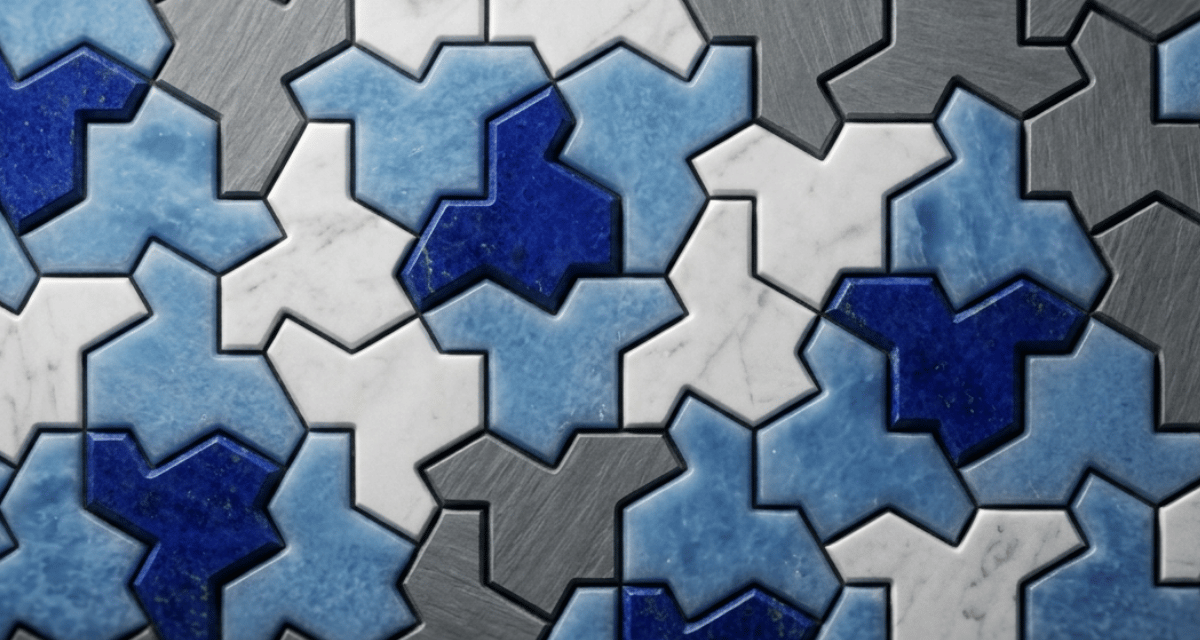
The story begins with the “ein Stein hat”, an aperiodic monotile discovered by amateur mathematician David Smith, which can cover a plane without ever repeating in a regular pattern. Its name comes from the German term for “one stone”.
In the new study, researchers at the University of Tokyo and collaborating institutions made nanoscale versions of the 13-sided hat pattern on silicon nitride films using electron-beam lithography. When they illuminated the structures with laser light, they saw distinctive pinwheel-like diffraction images with a clear handedness, meaning the patterns changed in a mirror image rather than remaining the same.
The paper’s senior author, Masaya Notomi, said the diffraction patterns become chiral because the structure itself lacks mirror symmetry, and he noted that this response is different from what is typically observed in conventional quasi-crystalline materials.
The team has also found that the optical pattern depends on the direction and polarization of the incoming light, and that mirrored versions of the structure reverse the optical behavior accordingly.
The finding matters because controlling chirality in light could be useful for technologies that rely on polarization, including telecommunications and quantum cryptography. More broadly, the work suggests that a shape, once known only for a pure mathematics breakthrough, may now serve as a platform for studying how aperiodic order and chirality interact in photonic systems. That kind of control could matter in quantum systems because single photons are often used to carry and process information.
If a structure can steer photons in a direction-dependent way, it may help build more reliable quantum networks, improve spin-photon interfaces, and support devices that route or filter quantum signals with less loss and noise.