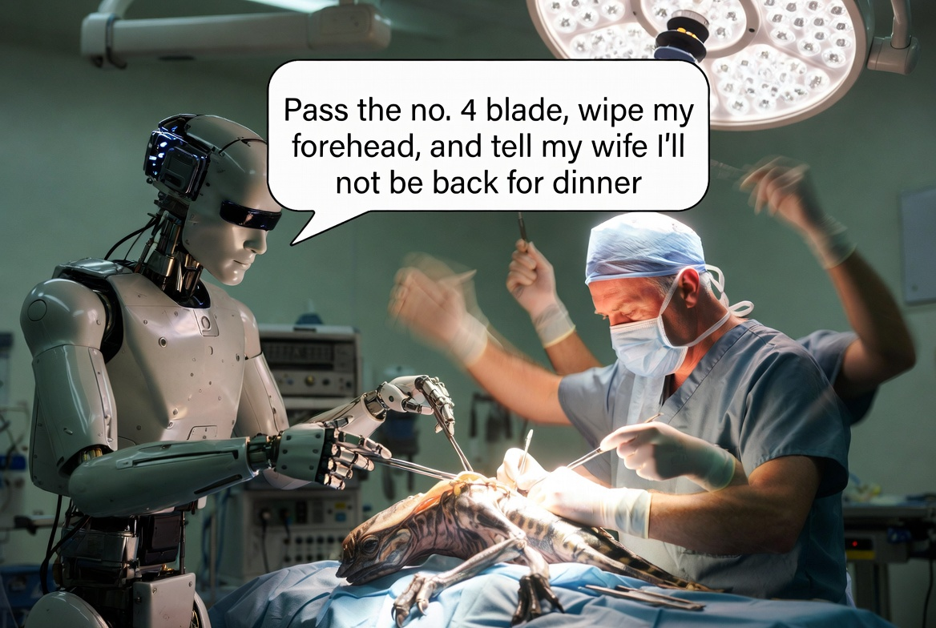





The next-gen surgical robots are taller, much lighter and more portable, making them more versatile than existing surgical robots when perfected.
Researchers at the University of California San Diego say they have carried out the first live surgical procedures using remotely operated humanoid robots, according to a report from UC San Diego Today and the study published in Nature).
In a preclinical trial and proof-of-concept, two successful operations were completed on large non-primate mammals, with one surgical team involving a human and a robot, and the other involving two robots working together.
In the first procedure, a humanoid robot working alongside a human surgeon (serving as an “assistant”) completed a gallbladder removal. The second procedure was performed by two humanoid robots operating side by side. Both surgeries were “tele-operated”, meaning the machines were guided remotely by surgeons rather than acting on their own. That distinction matters because the systems still relied on human control, even though robotics handled the physical motions of the operation.
The robots used are far smaller than many conventional surgical robots. They stand about five feet tall and weigh roughly 60 pounds (27.2KG), compared with specialized operating-room systems that can weigh around 1,800 pounds and often require major room modifications. The research team assert that this smaller footprint could make surgical robotics more practical in remote locations and under-resourced hospitals.
Room for further improvement
The work is still an early proof of concept, and the researchers say major obstacles remain:
- During the procedures, the robots needed to be recalibrated several times, which made the operations much slower than standard robotic surgeries.
- Latency, or the delay between a surgeon’s command and the robot’s response, is another unresolved issue, especially if the team eventually tries to operate over longer distances.
According to Shanglei Liu, an assistant professor of surgery at UC San Diego School of Medicine who teleoperated one of the robots, the first robotic laparoscopic surgery took six hours in the past, and now it takes about 30 minutes, suggesting that current limitations may improve with time and engineering refinement.
Looking ahead, the researchers envision humanoid robots doing more than just operating. They could eventually fetch tools, assist with setup, and clean up after procedures, creating a more integrated human-robot workflow in the operating room. The broader goal is a surgical environment where robots and people function as a team, especially in places where staffing shortages limit access to care. Liu also said the low cost and compact size could make the technology useful in rural areas, on battlefields, and even in space.