


SAS survey finds industry leaders on the cusp of quantum AI with real ROI. I found out more at SAS Innovate 2026.
As the supply chain to support quantum hardware stabilizes, many experts anticipate that this emerging technology will be popularized and production-ready by the early 2030s.
Some assume that means benefitting from quantum is out of the question for now. Enter quantum AI, a powerful approach involving running machine learning algorithms on existing quantum hardware.
In practice, applying quantum AI can look like helping organizations accomplish hours-long tasks in minutes, or rendering problems once considered impossible to realize on existing hardware. It can also look like calibrating models to learn efficiently on less data, bolstering stability over time – and much more.
What is quantum AI, and why do organizations want to use it?
SAS looks at classical and quantum computing as a spectrum: with proven classical computing on one end, and experimental and exponentially more powerful quantum computing on the other.
Many industry and business problems fall somewhere in the middle, with a hybrid approach splitting workloads: quantum processing and classical processing each doing what they do best.
“Organizations of all sizes are eager to develop intellectual property – their original, patented approach to quantum AI – so they’ll be ready as the technology comes of age,” said Bill Wisotsky, Principal Quantum Architect at SAS.
“Despite continued strong interest, leaders are understandably proceeding with caution, and they don’t want to go all-in on expensive quantum investments they fear may not result in worthwhile use cases and solved problems.”
To level the playing field, SAS hopes to establish real-world use cases for today, to help ensure that enterprises can get a piece of the quantum pie tomorrow, with people at the center of it all.
Quantum AI and synthetic data
Quantum AI and synthetic data reinforce each other. Quantum computing can generate, optimize, and train on synthetic data more efficiently than classical systems, while synthetic data helps quantum AI models overcome the scarcity of real quantum datasets.
Bryan Harris, CTO, SAS, said: “There are some things algorithms cannot do. Only humans can do those things, but that can be a very tedious exercise. Quantum AI can do it, especially with synthetic data.”
For instance, a quantum generative adversarial network(GAN) can generate synthetic molecular configurations for drug discovery faster than classical GANs.
Quantum systems don’t produce large labeled datasets the way classical domains do. Quantum ML models often need thousands to millions of samples; real quantum devices can’t produce that volume reliably. Synthetic data can fill that gap with:
- Simulated quantum states
- Artificial measurement outcomes
- Synthetic noise patterns
- Generated training sets for quantum classifiers
This, from my perspective, looks like one of the most promising convergence in next‑generation technologies. Emerging use cases include:
- Quantum‑generated synthetic medical data for drug discovery
- Quantum GANs for climate and financial simulations
- Synthetic quantum datasets for training error‑correcting codes
- Quantum‑enhanced synthetic data for robotics and autonomous systems
- Hybrid pipelines where classical AI generates coarse synthetic data and quantum AI refines it
Top barriers to quantum AI adoption in 2026
So, with all its potential benefits, what’s holding back organizations from greater investment?
SAS surveyed more than 500 global leaders across industries on quantum AI. In the first instalment of the survey in 2025, high cost of implementation ranked as the number one barrier to adoption, followed by lack of understanding or knowledge. That’s changed in 2026.
The greatest barriers to quantum AI adoption in 2026 ranked as follows among survey respondents:
- Uncertainty around practical, real-world uses
- High cost of implementation
- Lack of trained personnel
- Lack of knowledge or understanding
- Limited availability of quantum AI solutions
- Lack of clear regulatory guidelines
Preparing for the quantum economy
“This survey illuminates what SAS experts were already seeing in the market: that leaders are excited to use quantum, but the barriers to entry have been too high, and that requires a solution,” said Amy Stout, Head of Quantum Product Strategy at SAS.
At the conclusion of the survey, respondents had the option to answer a write-in question: if they were currently working on quantum, what use cases did they hope to achieve, or what business problem would they like to solve?
Responses included the following:
- To enhance the accuracy of fraud detection systems in financial services, enabling more efficient identification of complex transaction patterns.
- To optimize 5G network path traffic in real-time.
- To accelerate molecular simulation and the drug discovery process for new therapeutic candidates.
- For supply chain distribution and to optimize logistics problems.
- To improve machine learning workflows with a focus on predictive modeling for customer behavior.
- To train large language models for natural language processing tasks, reducing the time and resources for model optimization.
The real question is about people
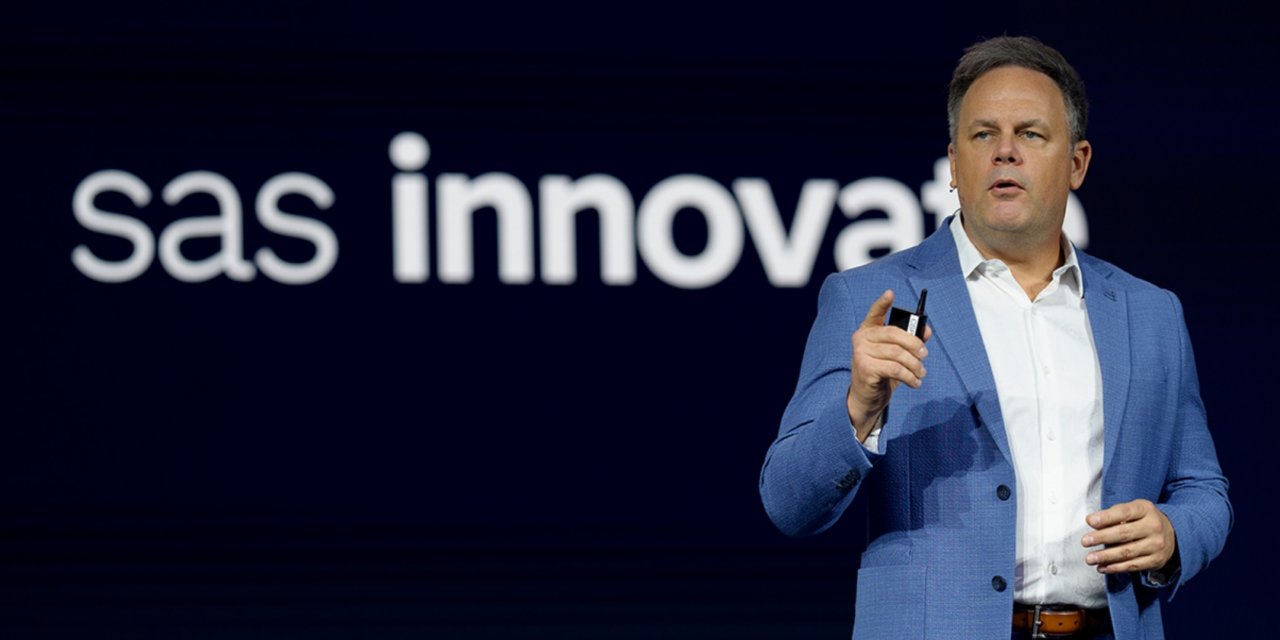
SAS CTO Bryan Harris gets into the issue early in his keynote at SAS Innovate 2026, asking: “Will people matter?”
And then he pushes it a step further: “We are in a crisis… a crisis of confidence in human ingenuity.”
Work is changing. Decisions that used to take time now happen instantly, or they happen inside systems that don’t really pause. There’s more data than people and organizations can realistically handle, and that gap keeps growing.
The crisis Harris alluded to sounds big, but it doesn’t feel abstract. And it isn’t about choosing between people and profit. Businesses can invest in people and still build something that lasts – with quantum AI.
Harris offered examples like scaling digital twins in manufacturing with Georgia-Pacific or simulating environments in healthcare, which sound AI-first but are not actually replacing people.
They are bringing people into testing, simulation and decision-making earlier, before anything happens for real.
It pays to be prepared. What is your organization planning to do with quantum AI and synthetic data…?