





A USTC team used rubidium atoms, photon interference, telecom wavelengths, and stabilization to surpass PLOB bound, enabling higher-rate transmission beyond 320km
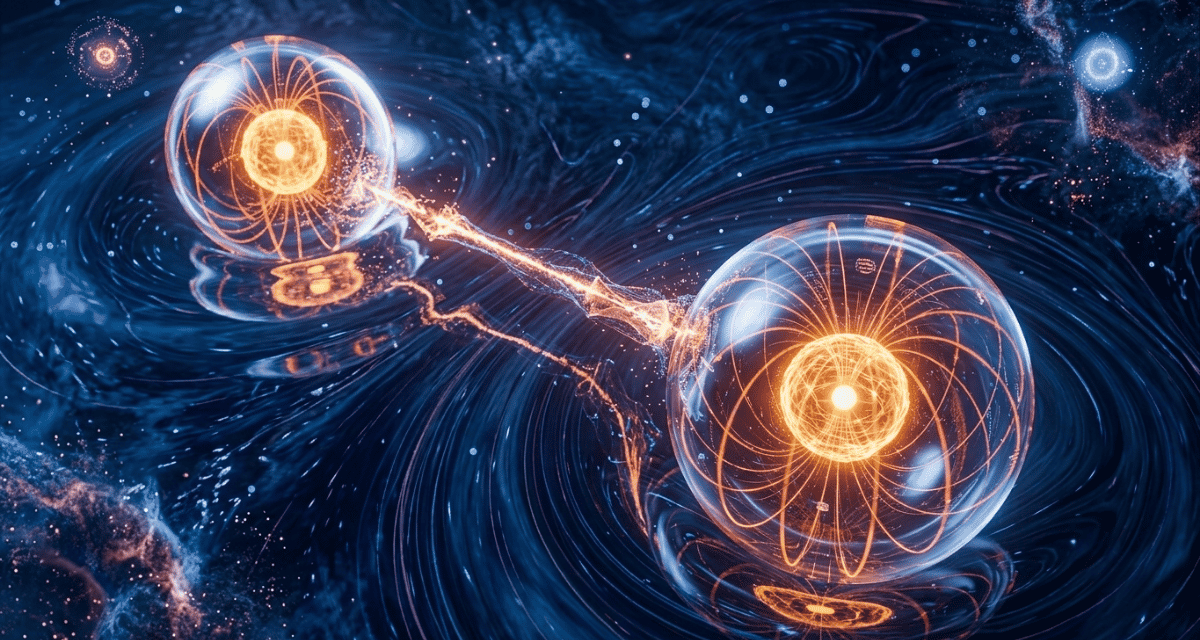
Researchers at the University of Science and Technology of China (USTC) have achieved a major milestone in quantum communication by successfully entangling two quantum memories over a distance of 420km using optical fiber.
This sets a new benchmark for fiber-based matter-to-matter entanglement, extending the achievable range to more than four times that of earlier experiments.
The study, led by Xi-Yu Luo, Chao-Yang Wang, and Ming-Yang Zheng, relied on laser-cooled ensembles of rubidium atoms to function as quantum memories. The two nodes, referred to as Alice and Bob, were positioned at opposite ends of the fiber link, while a midpoint station named Charlie played a critical role in verifying the entanglement.
Photons emitted from both memory nodes were directed towards Charlie, where their interference pattern was measured. When the expected pattern appeared, it confirmed that the distant quantum memories had become entangled.
Several technical innovations enabled this result:
- The team first converted photons emitted by the quantum memories into wavelengths compatible with telecommunications infrastructure, significantly reducing signal loss over long distances.
- They also implemented a stabilization mechanism that continuously compensated for environmental disturbances such as temperature variation and mechanical vibrations, both of which can disrupt fragile quantum states.
- In addition, the researchers used a single-photon entanglement protocol, meaning that only one photon needed to successfully traverse the fiber link rather than two, improving the overall efficiency of the system.
Beyond setting a distance record, the experiment also surpassed a key theoretical constraint known as the “Pirandola-Laurenza-Ottaviani-Banchi bound”. Established in 2017, this limit defines the maximum rate at which quantum information can be transmitted through a lossy channel without the use of repeaters.
Once the transmission distance exceeded 320km, the researchers observed that their system could generate entanglement at a rate higher than what direct optical transmission alone could achieve. This result provides strong evidence that quantum networks built around memory nodes can outperform even idealized direct fiber links.
Exploring quantum networking beyond metropolitan limits
Although a fully operational quantum internet remains a long-term goal, the ability to entangle stationary quantum memories across large distances is widely seen as a foundational capability. Earlier experiments had demonstrated entanglement over distances of about 50km in 2020, and roughly 20 km within urban environments in 2023. Extending this range to 420km marks a transition from city-scale implementations to intercity connectivity.
The researchers describe the system as a platform for exploring quantum networking beyond metropolitan limits. They also highlight that the setup can produce entanglement at relatively high rates over shorter distances of around 100km. This capability could play a role in developing quantum repeaters, which are essential components for linking multiple segments into large-scale, potentially continent-spanning quantum networks.