




What happens when AI and IoT are integrated to create smarter, more efficient systems that can collect, analyze, and act on data autonomously?
The impact on smart cities, enterprises and homes is deep and broad. The idea can be mind-boggling, but the convergence of AI and IoT – or AIoT – is becoming a reality faster than we imagine.
Innovative organizations and innovators are already riding the trend.
For instance, Advantech is collaborating with tertiary institutions across the region – Singapore, Malaysia, Thailand, Indonesia and Vietnam – to identify and groom young talents in AIoT.
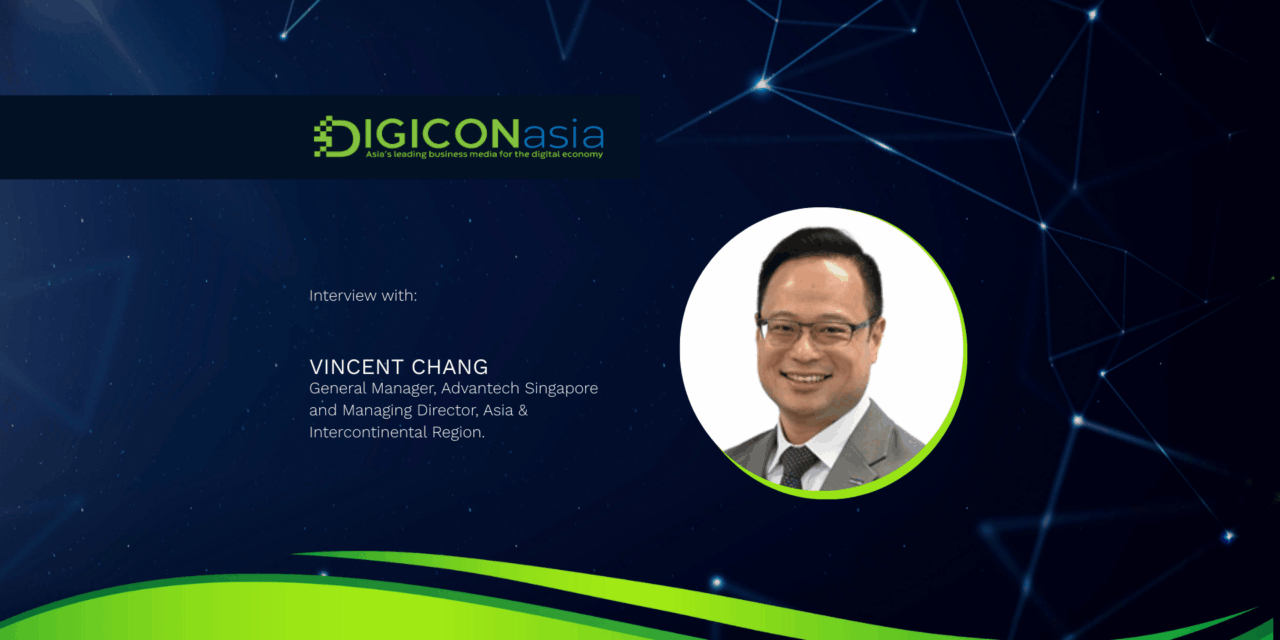
We interview Vincent Chang, General Manager, Advantech Singapore and Managing Director, Asia & Intercontinental Region, to find out more about developments in AIoT and its impact on sustainability in Asia Pacific, as well as ensuring the right talent is available.
How does AI advance sustainability goals for industries in Asia Pacific, based on Advantech’s strategy?
Chang: At Advantech, sustainability is not a side initiative – it is embedded in our corporate strategy through AIoT and edge intelligence. Our focus is on turning AI into a practical sustainability engine for industry, not just a digital upgrade.
Strategically, we operate around three pillars in ASEAN: Intelligent manufacturing, intelligent infrastructure, and intelligent services. Across all three, our sustainability approach is consistent – applying AI at the edge to reduce energy consumption, optimize operations, and extend asset lifespan.
| Application Domain | Key Strategy & Initiatives | Sustainability Outcomes |
| Energy & Utilities |
Deploy EMS/ECOWatch solutions compliant with ISO 50001. Support Net Zero 2050 goals and integrate BESS for grid stability. Utilize CarbonR solution for carbon inventory/ footprint calculation. |
Moves sustainability from reporting to action. Reduces energy waste, improves grid reliability, and creates a measurable data foundation. |
| Intelligent Manufacturing |
Implement PHM (Predictive Health Maintenance) to detect failures 1-3 months in advance. Use AI vision to reduce defect rates/scrap. Employ AGV/AMR for autonomous processes. |
Avoids unexpected downtime, increases OEE and energy efficiency, and reduces material waste. |
| Ecosystem & Services |
Transition from hardware supplier to a solution partner. Promote Solution-as-a-Service and develop the iFactory AI Agent platform to lower AI adoption barriers. |
Enables enterprise-wide deployment of AI-driven sustainability, accelerating digital transformation benefits. |
What makes this relevant in Asia Pacific is scale. Our customers operate across multiple sites and countries. Our strategy is therefore built on open platforms and ecosystem partnerships so AI-driven sustainability can be deployed enterprise-wide.
Ultimately, sustainability and performance move together. AI helps companies grow, reduce emissions, and improve resilience at the same time.
What is Edge AI and what is its significance for the future of key industries sectors such as manufacturing, energy, transportation, and healthcare?
Chang: Edge AI refers to the deployment of AI directly where data is created – on machines, equipment, and devices – instead of relying only on centralized cloud processing.
For Asia Pacific industries, Edge AI is essential for:
- Real-Time Intelligence: Enables decisions to be made in milliseconds (e.g., in factories or hospitals).
- High Resilience: Ensures systems continue operating even when network connectivity is limited or unstable.
- Operational Impact: Makes operations more reliable, efficient, and sustainable by analyzing data at the source.
| Sector | Core Contribution Edge AI | Key Actions/Solutions |
| Manufacturing |
From Automation to Autonomous Factories |
PHM (Predictive Maintenance): Detects faults 1-3 months in advance to boost OEE and reduce downtime. |
|
Real-Time Quality Control: Uses AI vision to minimize scrap, waste, and energy use (e.g., automotive). Digital Twins: Simulates and optimizes complex processes (e.g., semiconductor fabs). |
||
| Energy & Utilities |
Enabling Smart, Low-Carbon Infrastructure. |
Smart Energy Management: Edge-enabled iEMS/ECOWatch for ISO 50001 compliance and carbon asset management. Grid Digitalization: Uses edge gateways and standards (e.g., IEC 61850) for modern, remotely manageable grids. Renewables: Monitors wind turbines and manages BESS installations. |
| Transportation & Logistics |
Real-Time, Resilient Operations in Harsh Environments. |
Rugged Edge Platforms (NEMA-TS2): Built to operate in extreme temperatures and tolerate power interruptions (e.g., roadside traffic cabinets). Sensor Fusion: Combines data from LiDAR/Radar/Cameras at the edge for low-latency inference (e.g., adaptive traffic control, rail safety). |
| Healthcare |
Intelligent, Connected Care Systems. |
Medical Devices: Edge platforms handle local data acquisition and real-time analysis (e.g., patient monitoring, imaging) to reduce cloud dependency. Medical Robotics: Provides the computing foundation for AI-driven surgical and rehabilitation robotics. |
This is becoming essential for industrial sectors because it enables real-time intelligence, faster response, and higher system resilience. In environments such as factories, power stations, transport networks, and hospitals, decisions often need to be made in milliseconds, and systems must continue operating even when network connectivity is limited or unstable.
For Asia Pacific industries, Edge AI is not about experimentation – it is about making operations more reliable, efficient, and sustainable. It transforms how companies operate by allowing:
- Data to be analyzed instantly at the source
- Critical decisions to be made locally with minimal delay
- Sensitive data to remain on-site for security and compliance
- Systems to continue functioning even if cloud access is disrupted
What specific challenges in these various vertical industries do Edge AI and IoT help to address?
Chang: When companies adopt Edge AI and IoT, it’s rarely about technology for its own sake. It is driven by a set of very real operational challenges that cut across industries in Asia Pacific. Some of these challenges include:
| Challenges (pain points) | Edge AI / IoT solution (benefits) | Key mechanisms/examples |
| 1. Unplanned downtime & reliability risk |
Shift to condition-based maintenance |
AI-driven PHM (Predictive Health Maintenance) detects faults weeks or months in advance (e.g., pumps, motors), increasing asset availability and extending equipment life. |
| 2. High operating costs & energy inefficiency |
Real-time energy optimization |
iEMS/ECOWatch systems measure, analyze, and optimize consumption patterns (e.g., HVAC, compressors), reducing waste and supporting ISO 50001/ESG compliance. |
| 3. Data abundance but insight shortage |
Local, real-time insight generation |
AI models run at the edge to structure and contextualize data at the source, enabling front-line teams to act on immediate alerts and dashboards without cloud latency. |
| 4. Workforce constraints & safety concerns |
Automation and remote monitoring |
Automates routine inspection and data collection. Enables remote monitoring of hazardous assets (e.g., power lines), freeing skilled staff for higher-value tasks and improving overall safety. |
| 5. Fragmented systems & poor scalability |
OT/IT integration and standardization |
Edge Gateways/Switches act as the integration layer, connecting diverse legacy equipment, standardizing protocols, and enabling centralized visibility and regional scale-up across multiple sites. |
The question is no longer around what AI is – rather, the focus is on what problems it can solve. And that’s where IoT becomes critical, because it connects data, devices and insight into real operational outcomes.
However, technology is only part of the equation. The real long-term challenge is talent—building the right skills and capabilities to sustain this digital transformation. This is where our academic collaborations play a strategic role, which is the focus of the next question.
Talent and skill-set gaps can be a major obstacle. How would Advantech’s collaborations with academia in the region contribute to building the relevant talent and capabilities?
Chang: Talent development is one of the most strategic investments we can make as a technology company.
At Advantech, we believe industry transformation and workforce development must progress together. That is why our partnerships with universities and polytechnics go far beyond sponsorships – they are designed to develop skills that industry actually needs.
How can academic collaborations build capability?
1. From theory to real-world application
In many institutions, students learn concepts but lack exposure to real industrial systems. Our collaborations focus on:
- Providing industry-grade platforms for project work
- Enabling hands-on experience with AI, IoT and edge systems
- Exposing students to real operational challenges from industry
This shortens the gap between academic learning and professional readiness.
2. Creating industry-ready graduates
We work closely with institutions to align learning with industry needs. This includes:
- Internship opportunities in real engineering and solution environments
- Joint research and student innovation projects
- Mentorship from practitioners rather than only with academic lecturers
Through these efforts, we want to contribute to producing graduates who are job-ready, not just degree-qualified.
3. Building ecosystems, not just skills
We do not view talent development as an isolated effort. We building ecosystems that involve:
- Technology partners
- Industry participants
- Academic institutions
This creates an environment where innovation is co-developed rather than taught in isolation.
4. Supporting long-term digital resilience
Digital transformation is not a one-off project – it is continuous evolution. By investing in education, we help build:
- A sustainable pipeline of engineers and technologists
- A culture of innovation and applied learning
- Regional capability that strengthens the Asia Pacific technology ecosystem
Our partnerships ensure a sustainable pipeline of engineers and technologists familiar with industrial AI and IoT.
In the long run, technology does not create competitive advantage – people do. Our academic partnerships ensure that as industries digitalize, the region develops the talent and capability to sustain that transformation. That is how we futureproof both industry and workforce.
| Advantech’s academic partnerships within Asia Pacific 1. Singapore: Singapore Polytechnic: Preparing a National Polytechnic & Industry Hackathon Competition (Target: All Polytechnic in Singapore, Batam Polytechnic & Malaysia Polytechnic) with Talent Development & Industry Upskilling Collaboration Program. National University of Singapore (NUS): EDIC student project collaboration and Internship engagement 2. Thailand: Innowork Program with: Kasetsart University (KU), King Mongkut’s University of Technology North Bangkok (KMUTNB), King Mongkut’s University of Technology Thonburi (KMUTT) 3. Malaysia: Industry Project with partner and Universiti Sains Malaysia (USM) 4. Indonesia: Innowork Program targeting Politeknik Perkapalan Negeri Surabaya (PPNS), Politeknik Elektronika Negeri Surabaya (PENS), Politeknik Negeri Madiun (PNM) 5. Vietnam: Target on industry innovation competition with Vietnam-German University (VGU) for 10 Vietnam universities student competition. |