



As enterprises move AI from pilots into production, workload placement is becoming a key business decision, not just an infrastructure one.
Cost, performance, and scalability matter, but organizations also need to weigh latency, security, data sovereignty, and resilience when deciding what should run across cloud, on-premises, mainframe, and edge environments.
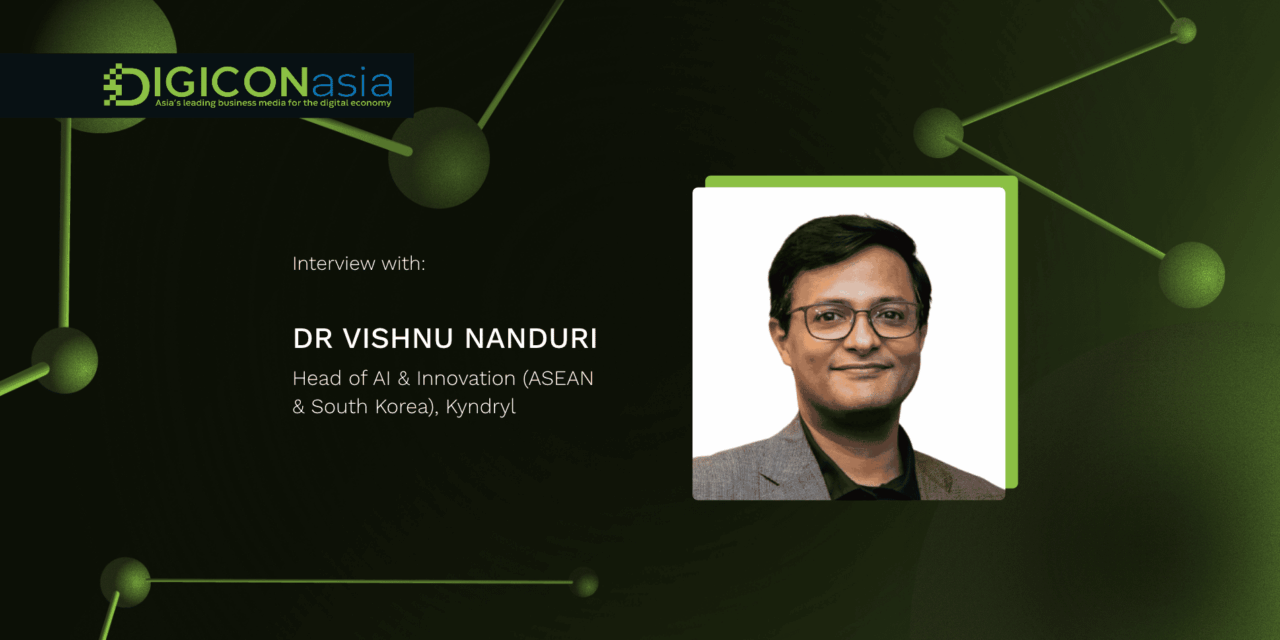
Dr Vishnu Nanduri, Head of AI & Innovation (ASEAN & South Korea), Kyndryl, shares his perspective on how enterprises should approach these trade-offs, and why getting workload placement right will become more important as AI moves deeper into business operations.

Dr Vishnu Nanduri, Head of AI & Innovation (ASEAN & South Korea), Kyndryl
As enterprises move AI from experimentation into production, why has AI workload placement become a business decision for ASEAN enterprises?
Dr Vishnu: Once AI moves into production, where it runs starts determining whether the business case works. During a pilot, the main question is whether the technology can solve a problem. In production, organizations must also ask whether it can perform reliably at scale, whether data can move where needed, whether it can be secured properly, and whether the economics hold up as usage expands. Infrastructure becomes part of the commercial and operational viability of the AI use case.
This is one reason the jump from experimentation to production can be difficult. Kyndryl’s 2025 Readiness Report found that 53% of AI projects in Singapore remained in the pilot stage, while 68% of organizations said their IT infrastructure was not fully ready to manage future risks. The model itself often works in isolation. The harder question is whether the systems, data and operating environment around it are ready to support it.
This is particularly relevant across ASEAN, where many large enterprises operate across multiple markets, regulatory environments and technology estates. A bank, for example, may have critical transaction data sitting on a mainframe, customer applications in the cloud, sensitive workloads in private environments and operations spread across several jurisdictions. A one-size-fits-all approach to AI placement can therefore create avoidable cost, latency, security and compliance challenges.
The better starting point is therefore not “cloud or on-premises” but what the workload must achieve, what data it depends on, how critical it is and what trade-offs are acceptable. The infrastructure decision should follow. This aligns with Kyndryl’s distributed-cloud approach, where workloads run across public cloud, private environments, on-premises infrastructure and edge according to data, regulatory and performance requirements.
What is the impact of rising infrastructure costs, data sovereignty requirements, latency needs, security risks and resilience expectations on organizations’ AI strategies?
Dr Vishnu: These pressures are making enterprise AI strategies more deliberate. Early adoption focused on gaining access to AI capabilities quickly and experimenting with what they could do. As organizations move use cases into production, the questions become practical: what will this cost at scale, where will the data travel, how quickly must the system respond, and what happens if it fails?
Cost is a good example. A pilot may be relatively inexpensive because usage is constrained. Once AI is embedded into a core business process, compute, storage, inference and data-movement costs can change significantly. Beyond whether the technology works, organizations must assess whether the value it creates remains compelling at scale. This is pushing enterprises to be more disciplined about which AI use cases they prioritize, where they place them and how they govern them.
Data sovereignty adds another dimension. Organizations must understand where data is processed, who can access it, what third-party dependencies sit behind the service and whether the business can continue operating if conditions change. Kyndryl’s 2025 Readiness Report found that 65% of organizations had changed their cloud strategies in response to geopolitical and regulatory pressures.
Agentic AI raises the stakes further because systems may access applications, call APIs or execute actions, not just generate information. This increases the importance of identity controls, monitoring, auditability and resilience. Enterprises are moving away from treating cloud as the default destination for every AI workload. Instead, workloads need to be placed according to economics, sensitivity, latency requirements and business importance.
In an increasingly hybrid infrastructure environment, how should enterprises assess cost, performance, latency, security, data sovereignty and resilience before deciding where AI workloads should sit as they move into production?
Dr Vishnu: The most useful starting point should be the workload itself and the business consequences if it succeeds or fails. Leaders should be clear about what the application must do, what data it uses, who depends on it and how damaging an outage, delay or incorrect decision would be. A recommendation engine and an AI system supporting fraud detection may use similar technologies, but their tolerances around latency, resilience and risk differ.
From there, organizations should assess economics, data requirements, performance needs and risk together: how production-scale usage affects costs, where data may reside or be processed, whether real-time responses are required, and what levels of cybersecurity, recovery, auditability and human oversight are needed.
Those requirements should determine placement. Public cloud may suit workloads prioritizing elasticity and rapid access to AI capabilities. Edge can be valuable where processing must happen close to data generation. Private cloud or on-premises environments may offer more control for sensitive workloads, while mainframes can remain central where critical data and transactions already reside. Kyndryl’s distributed-cloud positioning reflects the same principle: workloads should run where data, sovereignty, latency and performance requirements demand.
Placement should not be permanent. A workload may begin in a public cloud for faster experimentation, then move or become distributed as demand, economics, regulation or risk changes. The strongest architecture gives the business that flexibility, so no AI workload is locked into a single environment. Each workload should sit where it can deliver the strongest outcome at an acceptable level of cost and risk.