

As AI reshapes data center design across Asia, operators are contending with higher rack densities, rising power demand, and greater thermal complexity.
In this environment, improving efficiency is no longer just about selecting individual cooling or power solutions in isolation. It increasingly depends on how thermal management, power architecture, controls, and monitoring work together as an integrated system.
Vertiv’s new manufacturing facility in Senai, Johor, was launched recently to strategically support the growing demand for AI and high-density computing infrastructure across Asia. The facility’s capabilities include manufacturing large-scale thermal management, power and prefabricated infrastructure solutions for both AI and traditional data centers.
The solutions manufactured here are designed to handle the thermal output of next-gen AI chips, and include Vertiv CoolChip coolant distribution units for liquid cooling, Vertiv Power Module and Power Skid prefabricated power systems, and the SmartRun integrated overhead infrastructure system.
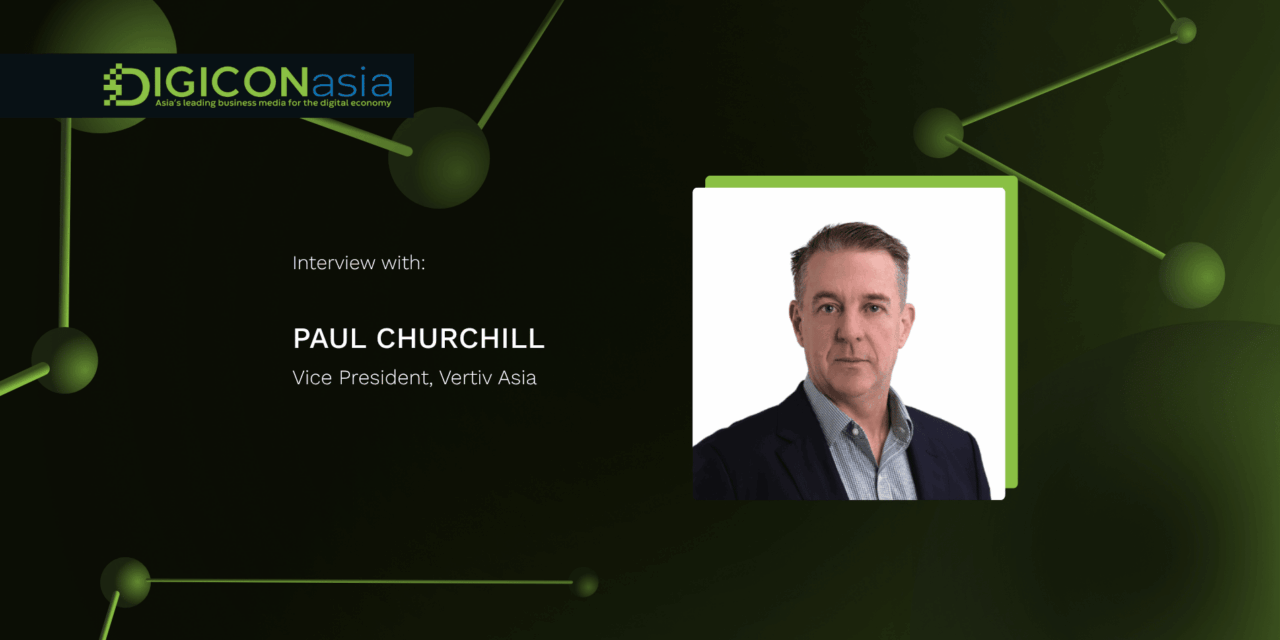
We spoke with Paul Churchill, Vice President, Vertiv Asia, about the changing demands brought on by AI and high-performance computing, and the impact on data center design and capabilities.

Paul Churchill, Vice President, Vertiv Asia
How and why is AI changing the efficiency equation for data centers, especially in Asia Pacific?
Churchill: AI is changing the way we think about data center efficiency because it is changing the workload profile itself. Traditional enterprise workloads are generally more predictable. AI workloads, especially those driven by GPUs, are more power-intensive and dynamic, which can create sharper shifts in demand for power and cooling. That means data center infrastructure must be able to respond reliably and efficiently from the grid all the way to the chip.
This shift is especially significant in Asia, where AI adoption, cloud services and enterprise transformation are already driving rapid digital infrastructure growth. Operators are managing higher rack densities, greater heat output, and increasing pressure on power availability across several markets. That changes the efficiency equation from a component-level discussion to a system-level challenge. It is no longer enough to simply install more power or cooling capacity.
For AI-ready environments, power, thermal management, IT systems, monitoring and services need to be designed as an integrated architecture. The goal is to support higher-performance compute while helping operators manage energy use, improve resilience, and reduce the operational impact of growth.
Why does system-level design matter for lower-impact, more efficient data center operations?
Churchill: In high-density AI environments, every layer of the data center is more closely connected. Higher chip density affects rack power. Rack power affects cooling requirements. Cooling design affects space, energy use, water considerations and serviceability. That is why the industry is moving toward a more integrated design approach.
Rather than treating power, cooling, IT and operations as separate systems, operators need to plan them as one interconnected architecture. Vertiv often describes this as viewing the data center as a unit of compute, where the full infrastructure, from grid to chip and chip to heat rejection, is designed to work together.
This approach can help reduce inefficiencies that arise when systems are added in isolation. It can also help improve scalability, reduce stranded capacity, shorten deployment timelines and support lower-impact operations. For example, advanced UPS systems, higher-voltage distribution, battery energy storage, liquid cooling and intelligent monitoring can work together to improve energy management and operational resilience.
Ultimately, system-level design is about making sure the infrastructure is prepared not only for today’s AI workloads, but also for the higher densities and more complex infrastructure requirements that are likely to follow.
Liquid cooling is only part of the answer in high-density environments. How do intelligent controls and monitoring help?
Churchill: As data centers move into higher-density AI environments, thermal management becomes more than a cooling challenge. It becomes an operational intelligence challenge. Liquid cooling is important because it can remove heat more effectively at the rack and chip level, but operators also need visibility into how the cooling system is performing, how it interacts with power demand, and where risks may be emerging across the facility.
AI workloads can fluctuate quickly, causing power draw and heat output to shift in real time. In that environment, operators need visibility into coolant flow, pressure, temperature, fluid quality and leak detection. These are not secondary considerations; they are central to maintaining reliability. A cooling distribution unit, for example, needs consistent power and close monitoring because even a short interruption in coolant flow can affect high-value AI infrastructure.
The goal is to move from reactive management to more predictive and proactive operations. That requires a holistic view of the facility, where power, cooling, and IT systems are monitored together rather than managed through separate dashboards. This is where integrated management platforms become important. For high-density AI facilities, this kind of connected oversight can support faster troubleshooting, better capacity planning, and more efficient day-to-day operations.
So, while liquid cooling helps remove the heat, intelligent controls and monitoring help operators manage the entire environment more effectively. The next phase of AI infrastructure will not just be about being liquid-cooled; it will be about being intelligently managed end to end.
What does all this mean for the next phase of digital infrastructure growth across Asia Pacific?
Churchill: The next phase of digital infrastructure growth in Asia will be defined by scale, speed, efficiency, and resilience. AI is accelerating demand for data center capacity, but the region cannot rely on conventional approaches alone. Power availability, grid constraints, land limitations, higher rack densities and environmental expectations are all shaping how facilities are designed and operated.
For operators, this means moving away from incremental upgrades and toward more integrated, AI-ready infrastructure. Modular and prefabricated systems can help speed deployment. Advanced power architectures can help manage higher densities. Liquid and hybrid cooling can support more demanding workloads. Intelligent monitoring can give operators the visibility needed to run these environments efficiently and reliably.
It also means collaboration will become more important. No single part of the ecosystem can solve these challenges alone. Data center operators, technology providers, utilities, governments and partners will need to work together to support digital growth while managing infrastructure impact. Vertiv’s role is to bring together power, cooling, IT infrastructure, software, analytics and services to help customers run critical applications continuously, perform optimally, and scale with business needs.
Across Asia, the opportunity is significant. The region is moving quickly into an AI-driven era, and organizations that take an integrated, resilient and energy-efficient approach will be better positioned to stay ahead as technology continues to evolve.