



AI’s competitive advantage will not come from performance alone. It will depend on how effectively organisations enable people and AI agents to securely access trusted data, wherever it resides.
AI is elevating storage into a strategic asset for enterprise control, performance, and innovation. Across Southeast Asia, this shift is already gaining momentum. According to research by McKinsey, Singapore’s Economic Development Board, and Tech in Asia, 81% of companies in the region have moved beyond experimentation into pilot and scaling phases.
As AI moves from experimentation to widespread adoption, the competitive advantage will not come from performance alone. It will depend on how effectively organisations enable people and AI agents to securely access trusted data, wherever it resides, while maintaining the governance and control that enterprise environments demand.
This is fundamentally changing the role of storage. Traditionally, storage systems were designed to hold, manage, and serve data to applications. In an agentic AI environment, however, AI agents are continuously discovering, retrieving, reasoning over, and acting on enterprise information. Every interaction consumes compute and tokens, making the quality and accessibility of underlying data increasingly important.

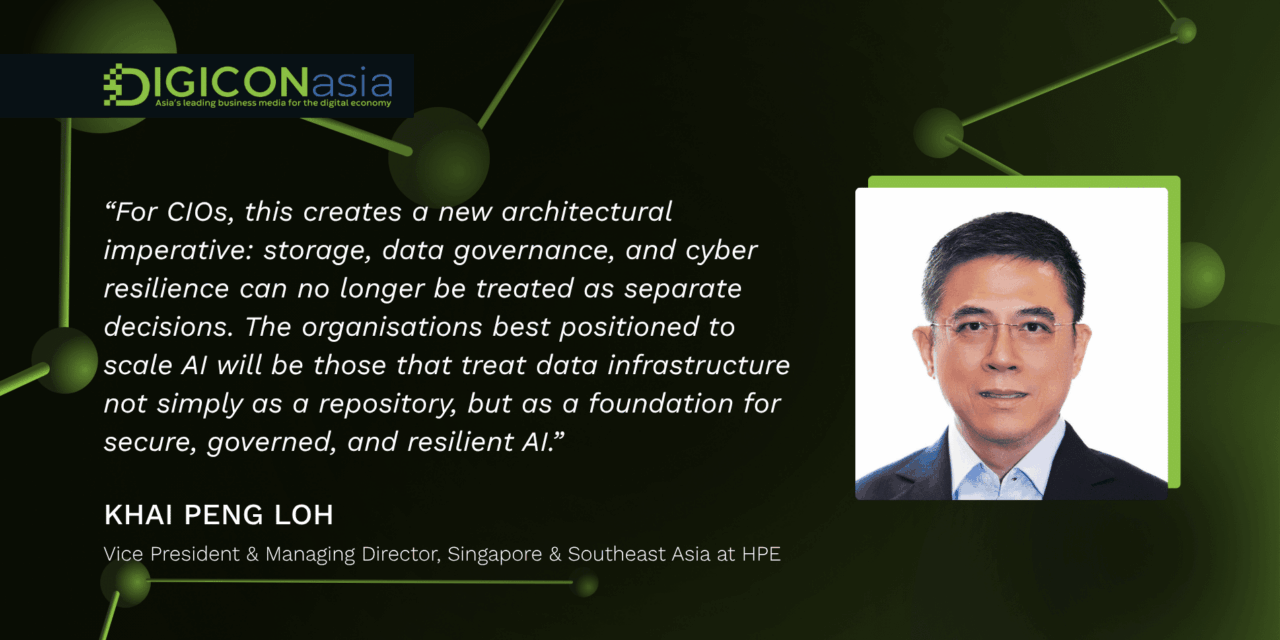
Khai Peng Loh, Vice President and Managing Director, Singapore and Southeast Asia, HPE
How data storage impacts AI
When data is fragmented, duplicated, poorly governed, or difficult to retrieve, AI becomes slower, more expensive, and less reliable. In fact, according to McKinsey’s AI data readiness: The key to scaling impact study, moare than two-thirds of high-performing companies say data is the primary obstacle for enabling AI.
Moreover, the pressure is on in the Asia-Pacific region for AI to begin demonstrating its returns. IDC projected that spending in the region will grow from US$121.5 billion in 2025 to US$555.2 billion by 2030 as enterprises scale AI beyond pilots. As adoption scales, infrastructure availability, scalability, and resilience become critical constraints.
For CIOs, this creates a new architectural imperative: storage, data governance, and cyber resilience can no longer be treated as separate decisions. AI agents need context, but context without control creates risk. They need speed, but speed without intelligent data placement can drive up costs. They also require broad access, but access without resilience can amplify disruption.
The organisations best positioned to scale AI will be those that treat data infrastructure not simply as a repository, but as a foundation for secure, governed, and resilient AI. For enterprises, this is becoming an increasingly important consideration as they move to scale AI across the organisation.
Moreover, the challenge becomes even more complex as AI draws increasingly on unstructured data such as documents and emails, which are often extracted, transformed, and reused across systems and applications. As AI expands from individual use cases to cross-functional workflows, enterprises need a data foundation that is not only accessible, but also traceable, reusable, and consistently governed.
In APAC, this is compounded by differing data-protection and data-residency requirements across markets: an enterprise operating across Singapore, Indonesia, Australia, and India, for example, must apply different rules to the same data. For enterprises across the region scaling AI, this makes the ability to establish trusted data foundations increasingly important.
How data trust is redefining the value of storage
This is where trust takes on greater importance, becoming a defining measure of storage value. It compels organisations to ask:
- Can the enterprise establish where information came from?
- Can it apply policy consistently across hybrid environments?
- Can it protect critical data and recover it quickly?
- Most importantly, can it deliver the right context to an AI agent without moving or copying everything first?
Trust also requires greater transparency across the AI ecosystem. That same principle, which is building trust in architecture, is reshaping how enterprises and the industry think about AI infrastructure.
To achieve this, storage architecture needs to bring block, file, and object storage together with consistent operational experience and a unified data layer for AI. The objective is bigger than simplifying infrastructure. It is to help CIOs govern distributed data, feed AI pipelines efficiently, and reduce the operational friction that keeps promising AI projects from reaching production.
Additionally, tokenomics allows CIOs to invest in other key priorities significant to the organisation’s success.
To withstand increasingly sophisticated cyber-attacks, cyber resilience must evolve as well. In an agentic enterprise, an attack still threatens stored information but can now also compromise the context on which automated decisions depend. That is why detection, immutable protection, continuous data protection, and orchestrated recovery must operate as part of the data architecture, not as safeguards added later.
Building trusted data foundations for AI at scale
The impact is already visible across a range of use cases:
- Airports can use trusted, real-time data to anticipate disruption.
- Racing teams can connect telemetry, design, simulation, and engineering data to enable faster decisions when every millisecond matters.
- Data-platform providers can give generative and agentic AI reliable enterprise context while working with customers’ existing data estates.
- The same applies in manufacturing. APAC is home to some of the world’s most concentrated semiconductor and advanced manufacturing hubs (such as in Singapore, Malaysia, Taiwan, Korea), where fabs and precision manufacturing lines generate vast amounts of equipment and process data across highly distributed, multi-country environments every day. That data has to be stored, protected, and governed consistently across sites before AI can put it to work.
If AI cannot access this trusted data in real time, use cases such as yield analysis and predictive equipment alerts can struggle to move from experimentation into day-to-day production.
Over the next five years, AI agents will become some of the most demanding consumers of enterprise data. Organizations that continue to separate storage, governance, and resilience will find it increasingly difficult to scale while keeping costs under control.
Those that build for data trust now will create a durable competitive advantage: AI will be able to make faster decisions because it is grounded in information the enterprise itself knows it can trust. That is the next standard for storage, and the architecture CIOs need to begin building today.