



RECENT STORIES:

Addressing digital sovereignty in a data-driven world
How the reputation of electric vehicles has faced policy and trust cha...
Why taking control of digital sovereignty is no longer optional
YY Group Expands Hong Kong Hospitality Portfolio; Commences Manpower S...
Hyundai Mobis Embeds 5G Wireless Telematics Technology for Autonomous ...
UnionPay at Davos: Transforming Cross-Border Payments with Connectivit...
LOGIN REGISTER
DigiconAsia
  • Features
    • Featured

      When AI and IoT converge

      When AI and IoT converge

      Thursday, January 15, 2026, 12:36 PM Asia/Singapore | Features
    • Featured

      Low-code platform enables digital-first agility

      Low-code platform enables digital-first agility

      Friday, December 26, 2025, 1:38 AM Asia/Singapore | Case Studies, Features
    • Featured

      Agents of change – the future of AI-powered e-commerce

      Agents of change – the future of AI-powered e-commerce

      Wednesday, December 24, 2025, 1:22 PM Asia/Singapore | e-Commerce, Features
  • News
    • Featured

      Will enhanced localization define Asia’s travel boom trends this year?

      Will enhanced localization define Asia’s travel boom trends this year?

      Wednesday, January 21, 2026, 5:14 PM Asia/Singapore | Future of Work, News, Newsletter
    • Featured

      Human supervision? Zealots argue that mortals cannot keep up with autonomous AI

      Human supervision? Zealots argue that mortals cannot keep up with autonomous AI

      Tuesday, January 20, 2026, 3:52 PM Asia/Singapore | News, Newsletter
    • Featured

      Islamic bank in Indonesia overhauls data systems post-merger for unified insights

      Islamic bank in Indonesia overhauls data systems post-merger for unified insights

      Tuesday, January 20, 2026, 5:56 AM Asia/Singapore | News, Newsletter
  • Perspectives
  • Tips & Strategies
  • Whitepapers
  • Awards 2023
  • Directory
  • E-Learning

Select Page

Features

State of quantum computing in Asia Pacific

By Victor Ng | Friday, December 12, 2025, 5:41 AM Asia/Singapore

State of quantum computing in Asia Pacific

As quantum computing technologies gain prominence, Asia Pacific governments’ efforts to engage top quantum companies and experts globally seem to be bearing fruit.

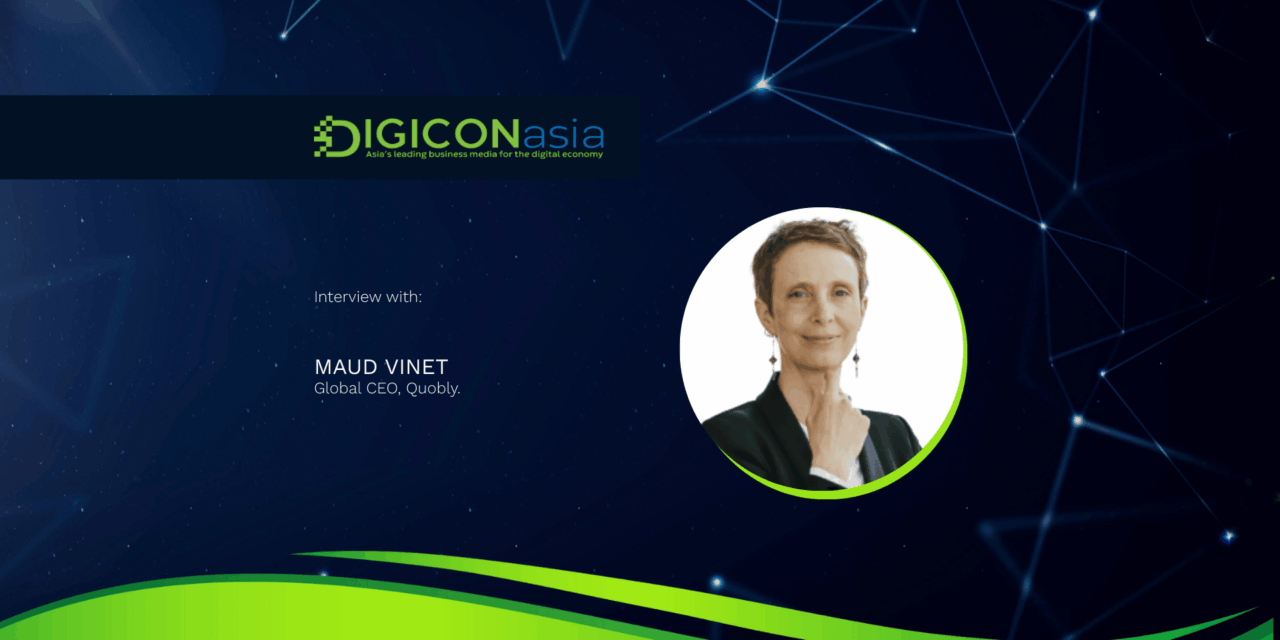
A unique leader in the field who has invested in the region is Maud Vinet, Global CEO of French quantum startup Quobly, which has recently incorporated an office in Singapore. 

Vinet is one of the few women leaders in a space dominated by men, with worldwide authority and deep knowledge in the space, underlined by 80 patents and 300 scientific papers, and with the unique ability to demystify complicated quantum physics theory into understandable concepts. 

We gleaned key insights into quantum computing and AI from her in this Q&A…

What is the current state of quantum computing globally and in Asia Pacific?

Vinet: Quantum computing has reached a turning point worldwide, the physics is proven, the first prototypes work, and the challenge now is to make them manufacturable and scalable. The race is no longer about who can show the largest number of qubits, but who can build them reliably, at scale, and with industrial methods.

In Asia Pacific, the momentum is particularly strong. Countries like Japan, South Korea, Australia, and Singapore are developing full-stack ecosystems backed by strategic government programs. Singapore stands out for its application-driven and ecosystemic approach: rather than trying to build everything in-house, it focuses on becoming an intelligent end-user and integrator of quantum technologies.

At Quobly, we have been very impressed by the clarity of Singapore’s National Quantum Strategy and by the depth of its research ecosystem. This unique mix of public support, academic excellence, and industrial openness creates a fertile ground for meaningful quantum collaborations.

Where are the innovations in hardware and/or software that are driving quantum technologies?

Vinet: The key hardware innovations are coming from scalable and manufacturable qubit platforms.

At Quobly, we focus on silicon spin qubits, which turn a standard transistor into a qubit. This means we can fabricate quantum chips using the same CMOS technology as today’s semiconductor industry. It is a radically different path from large, complex laboratory systems: our quantum integrated circuits are compact, robust, and compatible with industrial production.

As part of our international expansion, Quobly has officially incorporated in Singapore to strengthen partnerships with leading research institutions and semiconductor players in the region. This expansion complements our R&D activities in France and supports the cross-validation and benchmarking of spin qubits, which is an essential step toward reliable, manufacturable quantum processors.

This move illustrates how Singapore’s quantum ecosystem combines deep scientific expertise with an industrial mindset, creating an ideal environment for translating quantum research into scalable technologies.

What are some key challenges and opportunities in the quantum computing space?

Vinet: The main challenge today is scalability. Current quantum prototypes can control a few hundred qubits, but these are still highly fragile and difficult to reproduce. To deliver useful computation, the industry must scale up to hundreds of thousands or millions of qubits, while improving yield, reproducibility, and control electronics.

Achieving this requires a complete shift from delicate laboratory setups to industrial semiconductor fabrication. That is precisely what Quobly is pioneering, together with STMicroelectronics, by leveraging CMOS technology to manufacture spin qubits on 300 mm wafers.

The opportunities are vast. Quantum computing will unlock new capabilities in materials science, chemistry, energy, and optimization, solving problems that are currently intractable for classical computers.

In the midterm, hybrid quantum-classical systems will help accelerate simulation and optimization workflows, delivering real-world value long before full-scale fault-tolerant machines are available.

How intermingled is the relationship between AI and quantum?

Vinet: AI and quantum computing are increasingly intertwined. At Quobly, we are exploring the use of advanced algorithms and machine learning to support the calibration and control of silicon spin qubits. These tools help analyze experimental data and optimize control sequences during R&D.

Looking ahead, quantum computing is expected to unlock new opportunities for AI, enabling it to tackle more complex simulations and optimization tasks than currently possible on classical hardware.

In this sense, AI contributes to making quantum experiments more precise and reliable, and quantum computing has the potential to make AI more powerful in the future.

Vinet: Organizations should start engaging now, even if they are not building quantum hardware. The focus should be on developing quantum-ready applications and building in-house expertise to understand which problems can benefit from quantum computing.

Participating in collaborative platforms, pilot programs, and user communities helps identify relevant use cases early, such as optimization, logistics, or advanced materials.

Companies like Quobly are working closely with regional partners to demonstrate scalable, manufacturable quantum systems, providing opportunities for early engagement and knowledge transfer.

Asia Pacific is particularly well-positioned for this pragmatic approach: governments are supportive, the industrial base is strong, and countries like Singapore combine technical excellence, forward-looking policy, and international openness. This creates a natural bridge between quantum research and commercial deployment.


Share:

PreviousMMTEC, Inc. Announces Receipt of Nasdaq Decision Regarding Minimum Bid Price Deficiency
NextNexteer Builds on Growth Momentum at 2025 Global Strategy Summit in Suzhou, China

Related Posts

NZ’s largest university plots a proactive path for migrating to composable ERP

NZ’s largest university plots a proactive path for migrating to composable ERP

July 26, 2023

Managing business travel risks in a permacrisis: If the tech fits, use it!

Managing business travel risks in a permacrisis: If the tech fits, use it!

October 17, 2023

Security Bank modernizes eKYC for seamless, secure digital onboarding

Security Bank modernizes eKYC for seamless, secure digital onboarding

April 10, 2025

Are enterprises locked-in to their ERP software vendor’s support services?

Are enterprises locked-in to their ERP software vendor’s support services?

November 28, 2022

Leave a reply Cancel reply

You must be logged in to post a comment.

Awards Nomination Banner

gamification list

PARTICIPATE NOW

top placement

Whitepapers

  • Achieve Modernization Without the Complexity

    Achieve Modernization Without the Complexity

    Transforming IT infrastructure is crucial …Download Whitepaper
  • 5 Steps to Boost IT Infrastructure Reliability

    5 Steps to Boost IT Infrastructure Reliability

    In today's fast-evolving tech landscape, …Download Whitepaper
  • Simplify Payroll Setup for Your Small Business

    Simplify Payroll Setup for Your Small Business

    In our free guide, "How …Download Whitepaper
  • Overcoming the Challenges of Cost & Complexity in the Cloud-first Era.

    Overcoming the Challenges of Cost & Complexity in the Cloud-first Era.

    Download Whitepaper

Middle Placement

Case Studies

  • When 24/7 engagement means so much to students: University of Malaysia Nottingham

    When 24/7 engagement means so much to students: University of Malaysia Nottingham

    That is what prompted the …Read More
  • Harnessing the data lakehouse and AI to revolutionize customer experience

    Harnessing the data lakehouse and AI to revolutionize customer experience

    UOB achieved 99% cash availability …Read More
  • Bhutan sovereign wealth fund pilots offline data relay to stabilize distributed-ledger challenges

    Bhutan sovereign wealth fund pilots offline data relay to stabilize distributed-ledger challenges

    Amid remote connectivity gaps in …Read More
  • Low-code platform enables digital-first agility

    Low-code platform enables digital-first agility

    Few industries demand agility and …Read More

Bottom Sidebar

Other News

  • YY Group Expands Hong Kong Hospitality Portfolio; Commences Manpower Services for 12 Top-Tier Hotels

    January 21, 2026
    Contracts Expected to Increase YY Circle …Read More »
  • Hyundai Mobis Embeds 5G Wireless Telematics Technology for Autonomous and SDV Vehicles

    January 21, 2026
    – Hyundai Mobis has developed …Read More »
  • UnionPay at Davos: Transforming Cross-Border Payments with Connectivity and AI

    January 21, 2026
    DAVOS, Switzerland, Jan. 21, 2026 …Read More »
  • ELECFREAKS and Sub-Brand TOOCAA to Showcase CreatAI and STEAM Innovation at BETT 2026

    January 21, 2026
    SHENZHEN, China, Jan. 21, 2026 …Read More »
  • Xinhua Silk Road: Cross-border e-commerce export goods return central warehouse in E. China’s Weihai boosts industrial dev’t

    January 21, 2026
    BEIJING, Jan. 21, 2026 /PRNewswire/ …Read More »
  • Our Brands
  • CybersecAsia
  • MartechAsia
  • Home
  • About Us
  • Contact Us
  • Sitemap
  • Privacy & Cookies
  • Terms of Use
  • Advertising & Reprint Policy
  • Media Kit
  • Subscribe
  • Manage Subscriptions
  • Newsletter

Copyright © 2026 DigiconAsia All Rights Reserved.