




The key challenge for APAC enterprises is not whether to adopt AI. It is how to move from fragmented pilots to production-scale solutions that deliver measurable business impact.
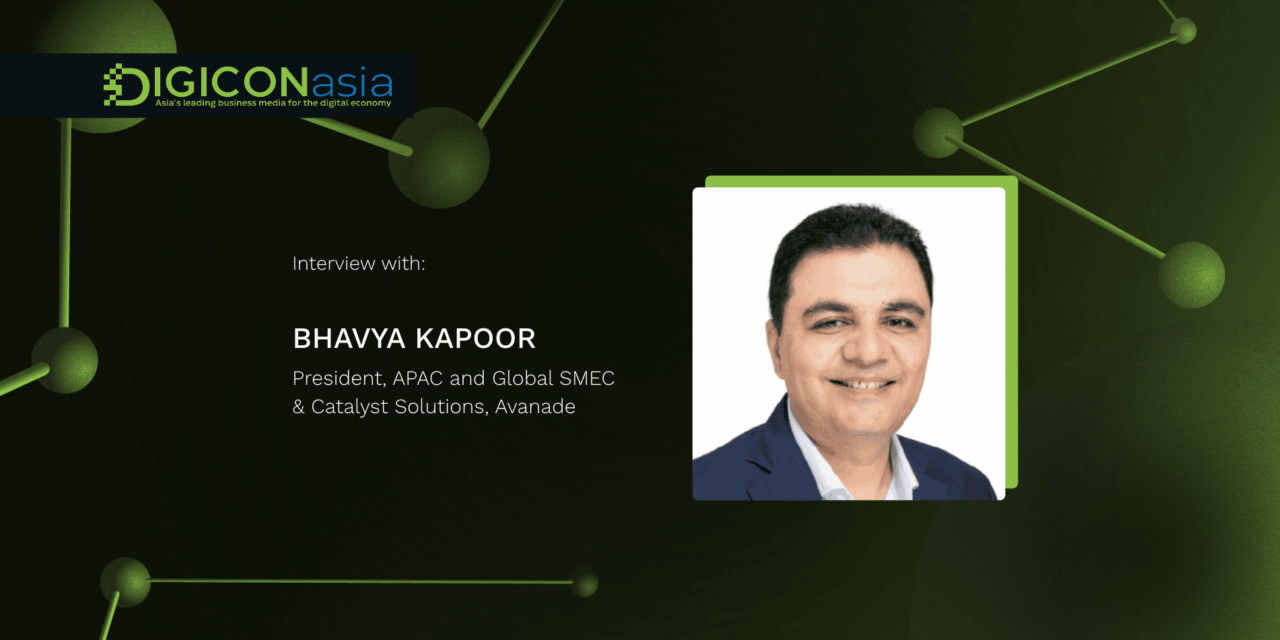
In a conversation with Bhavya Kapoor, President, APAC and Global SMEC & Catalyst Solutions, Avanade, we gleaned some key insights into the challenges Asia Pacific organisations are facing when implementing their AI strategies:
What are the key AI developments that you are seeing across the APAC region?
Bhavya Kapoor (BK): Across the region, we are seeing a significant shift in how organizations think about AI. The conversation has moved from “should we use AI?” to “how do we scale AI in a way that is secure, governed, and tied to business value?”
That shift is happening because the ambition is clearly there, but execution is still uneven. Avanade’s Trendlines AI Value Report 2025 found that 44% of mid-market organisations are still stalled at the proof-of-concept stage, while 48% are still developing the business case for AI. At the same time, 85% of mid-market leaders fear losing competitive advantage without rapid AI adoption.

Bhavya Kapoor, President, APAC and Global SMEC & Catalyst Solutions, Avanade
So, the urgency is real. As a leading Microsoft expert, Avanade brings together AI, cloud, data, security and change management capabilities. That combination matters because AI value is no longer just about the tool. It is about helping organisations embed AI into how their businesses actually work.
AI has existed in different forms for decades. What makes this current wave different?
BK: AI as a concept is not new. Earlier forms, such as expert systems, have existed for decades. What has changed is accessibility, scale and speed.
Generative AI has made AI highly visible and usable for a much broader group of people. Agentic AI takes that further by enabling systems to perform tasks, initiate workflows and support decision-making in more operational parts of the business.
That changes the enterprise conversation. AI is no longer only a specialist technology used by technical teams. It is becoming part of how people work, how businesses serve customers, how operations are managed, and how organisations respond to change.
The pace is also different. Previous technology shifts, such as digital and cloud, unfolded over many decades. The AI shift is moving much faster. That creates opportunity, but it also puts pressure on leaders to build the right foundations quickly: trusted data, cybersecurity, governance, workforce capability and clear business ownership.
There is increasing discussion about AI being used in sensitive areas, including defense. How should organisations think about that?
BK: AI will increasingly appear in many parts of society, including highly sensitive sectors. The issue is not simply whether AI will be used, but how it is governed.
In areas such as healthcare, public services, cybersecurity and defense, the risks are clearly higher because the consequences of poor decisions can be significant. That is why responsible AI cannot be treated as a policy document or a compliance exercise. It must be built into the way systems are designed, deployed, monitored and improved.
The focus should be on clear governance, defined accountability, strong guardrails, human oversight and international alignment where possible. The more powerful the technology becomes, the more important it is to ensure that it is used with discipline and responsibility.
For any organisation deploying AI in sensitive environments, the starting point should be clear boundaries: what the system is allowed to do, what it is not allowed to do, when a human must intervene and who remains accountable for the outcome.
What does this mean for mid-market organisations that may not have the same resources as large enterprises?
BK: Mid-market organisations face a different challenge. They often need to move quickly, but they may not have the same level of in-house capability, cybersecurity resources or governance capacity as larger enterprises.
That means the approach has to be practical and fit for purpose. The priority is not to replicate a large-enterprise transformation program. It is to start with repeatable foundations that help mid-market organisations secure data, govern AI use and scale responsibly.
This is why productised and repeatable solutions are important. They can give mid-market organisations a faster starting point, especially in areas such as cybersecurity, data protection and AI governance. The commercial model also needs to make sense for the mid-market, where investment pools are often more constrained.
The goal should not be to give smaller organisations a lighter version of enterprise complexity. It should be to give them practical foundations that allow them to adopt AI responsibly, securely and with a clear path to measurable value.
How should companies think about measuring ROI from AI, especially for tools such as Copilot?
BK: It is difficult to measure the ROI of productivity tools in a purely financial way. We did not ask for the ROI of email, mobile phones or collaboration tools in the same way. These technologies became part of how work gets done because they have improved the way people communicate and operate.
Copilot and similar tools can have the same effect. They help people complete tasks faster, summarize information, draft content and respond more efficiently. That creates productivity gains, but it may not always be easy to map directly to the profit and loss statement.
The bigger opportunity is when AI moves from productivity to business transformation. That is where companies should measure value through business outcomes: faster customer response, better service quality, improved revenue generation, stronger employee experience, reduced risk or new business models.
Many organisations are increasing AI budgets and expecting fast returns. Avanade’s Trendlines AI Value Report 2025 found that 87% of mid-market organisations expect to increase AI budgets by up to 50%. That level of investment raises the bar for measurement. Leaders need to show where AI is improving growth, service quality, risk reduction or operational performance, not just usage.
For too long, organisations have focused on doing more with less. AI creates an opportunity to think differently: how do we do more with more? How do we use AI to create new sources of value, not just reduce cost?
Can you share an example of how Avanade is applying AI to create real business impact?
BK: One example in Singapore is our work with Alexandra Hospital on CareScribe, a platform designed to support nursing handovers.
Healthcare organisations face both capacity and quality challenges. During shift changes, there can be a gap between experienced nurses handing over information and less experienced nurses taking over care responsibilities. That handover process is critical because it affects continuity of care.
CareScribe uses AI to capture information in natural language, correlate it with relevant context and help prepare the nurse receiving the handover. It is a simple but meaningful example of how AI can support frontline workers, improve consistency and create human impact.
This is the kind of work that reflects Avanade’s mission to make a genuine human impact. AI should not only be about productivity or automation. It should help people do important work better, especially in sectors such as healthcare, public services, utilities and customer service.
Across the region, we are seeing more examples of organisations moving from AI experimentation into applied, business-ready use cases, including 7,000 hours saved at PageGroup and 90% faster customer response times at Japan Airlines. The most successful examples are not about using AI for its own sake. They are about solving real problems, improving workflows and delivering measurable outcomes.
What is your advice to organisations that want to become more AI-ready?
BK: Start by being clear about the business problem. AI should not be deployed simply because the technology is available. Organisations need to identify where AI can improve customer experience, employee experience, operational performance or growth.
Second, build the right foundations. That means data readiness, cybersecurity, governance, responsible AI, workforce capability and change management. Many organisations start with Copilot, but the bigger opportunity is connecting AI into the wider Microsoft ecosystem across cloud, data, security, business applications and workflows.
Third, distinguish between AI used for productivity and AI used for transformation. Productivity tools are important, but they are only the first step. The larger opportunity comes when AI is embedded into the core of how the business operates.
Finally, leaders need to move with urgency but not recklessness. AI adoption is accelerating, and the window for competitive advantage will not remain open indefinitely. The organisations that succeed will be those that move from experimentation to execution while keeping trust, governance and people at the center.
The central challenge for APAC enterprises is not whether to adopt AI, but how to move from fragmented pilots to production-scale solutions that deliver measurable business impact.