


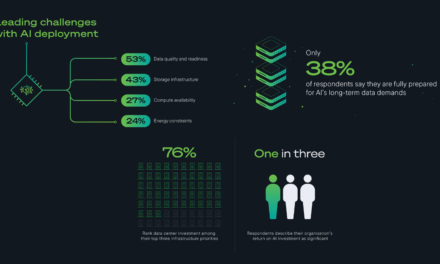
With the growing demands on digital infrastructure from the rise of technologies such as AI and quantum computing, how can data centers in Asia fuel growth without breaking the energy equation?
Data centers in the region are doing a balancing act — managing rising digital demand while attaining energy efficiency goals.
How can the data center ecosystem develop digital infrastructure that is sustainable at scale, and what is the outlook like for data centers in Asia in 2026 and beyond?
At the sidelines of Asia’s flagship ATxSG 2026 event, we discussed the challenges and opportunities for data centers in the region with Tanya Ahuja, Vice President, Corporate Development and Strategy, APAC, Equinix.
Rising digital demands due to AI and quantum computing are putting pressure on data center capacities, while operators are also expected to meet energy efficiency goals. How should data center operators strike a balance between the two?
Tanya Ahuja (TA): Digital infrastructure is key to AI success, and that’s fueling the rapid data center expansion globally. This demand puts pressure on global resources which requires operators to look far beyond meeting immediate needs.
This means thinking beyond adopting energy-efficient equipment to consider other important factors such as location, design, and construction practices. This holistic approach is needed to safeguard our precious resources and offers us an opportunity to work with our stakeholders (governments and enterprises) when planning capacity.
At Equinix, sustainability is top of mind from choosing location, to how we build and operate digital infrastructure. A data center needs to be planned responsibly from day one, because the biggest decisions that shape long-term energy use, water needs, and community impact are made early, and are hard to change later.
We consider whether there is reliable power, a credible pathway to cleaner energy, how water will be managed, and what the impact on nearby communities could be. We also factor in climate and weather, because they influence cooling demands and long-term efficiency.
That’s why we monitor key indicators like Power Usage Effectiveness (PUE) and Water Usage Effectiveness (WUE), and we also track supporting measures that help us pinpoint what’s driving performance – such as cooling efficiency, how the facility performs at different load levels, and the carbon intensity of the electricity powering our operations. This gives us the visibility to make targeted improvements over time, not just one-off fixes.
As governments and enterprises in Asia Pacific plan for future growth, how can digital infrastructure be sustainable at scale?
TA: Beyond addressing energy efficiency and data center designs, scaling digital infrastructure responsibly also depends on securing cleaner power at scale. We help customers progress on both efficiency and sustainability. We see these as separate but connected goals: run data centers efficiently while also shifting the energy they use toward renewable, lower-carbon sources—so customers can scale compute-intensive workloads responsibly.
We’ve adopted a multifaceted approach to expand renewable energy coverage across our data center portfolio, with power purchase agreements (PPAs) as a key lever to help bring new renewable capacity onto local grids. Signing PPAs allows us to support projects such as solar farms and thus add new renewable energy capacity to local grids. Across APAC, we signed renewable energy power purchase agreements (PPAs) in Singapore, Australia, India and Japan to improve the quality of our renewable sources.
Renewable energy alone can’t meet the energy capacity demands of data centers. All low-carbon power sources, including hydrogen and nuclear energy, must be considered. Equinix is taking steps globally to diversify its clean energy mix. We are exploring low carbon energy solutions such as hydrogen and nuclear, in addition to traditional grid solutions, and looking at using AI to reduce energy impact.
In Singapore, we announced a funding commitment of over S$9 million through 2028 to accelerate the nation’s clean energy transition and innovation. This first-of-its-kind program brings together industry and academia to explore viable energy options in Singapore, including renewables, cross-border electricity import, nuclear power, hydrogen and more.
What are some other key data center trends we should be aware of in 2026 and beyond?
TA: The outlook for data center buildout in APAC is exceptionally strong and accelerating. According to Cushman & Wakefield, the region’s data centre development pipeline continued to scale in H2 2025, expanding by 2,751MW to reach 19,371MW. Asia-Pacific is also a strategic market for Equinix. We operate 64 data centers across 18 markets and have announced 13 additional expansions and new builds, representing more than US$1.7 billion in planned investment.
While energy remains a key consideration for the sector, we continue to see meaningful opportunities driven by rapid hyperscale and cloud expansion, broader enterprise adoption of emerging technologies including AI.
Against this backdrop, key trends to watch in 2026 and beyond include:
- First, AI growth will increasingly be shaped by physical constraints, including power availability, land scarcity and cooling limits – factors that will determine where and how capacity can be added.
- Second, resilience will become a baseline requirement, as enterprises and governments treat always-on digital infrastructure as essential to operations and service delivery.
- Third, data sovereignty will remain a priority without driving fragmentation. Organisations will lean more heavily on hybrid architectures that meet local regulatory requirements while still enabling cross-border collaboration and scalability.
- Fourth, AI workloads will move closer to users and data. As inference, real-time decisioning and agentic systems expand; low-latency infrastructure and edge proximity will become increasingly important.
- Finally, sustainability will become a prerequisite for growth. In power-constrained markets, credible progress on energy efficiency and low-carbon energy sourcing will increasingly influence where expansion is possible.